Orthodox Knowledge
← Home

Reading the Icons

An icon is not a portrait or a religious painting but a window onto the Kingdom, written (not merely painted) according to a received grammar. Its every feature is theological. The Seventh Ecumenical Council (787) confirmed that the honor we give the icon passes to the person it depicts, for since God became visible in Christ, He and His saints may be shown.

The grammar of the icon

Gold background
Not a place but the uncreated light of God's Kingdom, eternity rather than a landscape. The figures stand already within heaven.
Inverse perspective
Lines open outward toward the viewer instead of receding to a vanishing point, so the icon reaches out to you rather than drawing you into an illusionary depth. The point of meeting is the person who prays.
No cast shadows
The saints are filled with light and cast no darkness; their bodies are shown transfigured, already sharing in the life of God.
Elongated, stilled figures
Bodies are spiritualized rather than naturalistic, the flesh quieted and at peace, to show humanity restored and deified, not anatomy.
Large eyes, small mouth
The senses are reordered toward God: eyes and ears enlarged to behold and hear Him, the mouth small, for the saint lives in prayerful silence rather than appetite or chatter.
The inscription
An image becomes an icon when it is named; the inscribed name binds it to its prototype. Christ is marked IC XC (and in His halo the words “He Who Is”), the Theotokos MP ΘY, “Mother of God.”
The halo
Not a flat disc of fame but the uncreated glory, the grace of the Holy Spirit shining from within the saint who has become light.

How the saints are depicted

A saint is shown not as he looked on a given day but as the Church knows him: the same recognizable face from icon to icon, with attributes that tell you at a glance who he is and how he served Christ.

A Gospel or scroll
Marks a teacher of the Church, the evangelists, the great hierarchs and fathers, and the hymnographers, who handed on the word of God.
A cross in the hand
A small upright cross is the sign of a martyr, the witness who bore the Cross of Christ to the end and holds the instrument of his own victory.
Bishop's vestments
The omophorion, a wide band over the shoulders, with a hand raised in blessing, shows a bishop; the great hierarchs are vested so and usually hold the Gospel.
Armor and weapons
Armor, a spear, or a sword marks the warrior saints (George, Demetrios, Theodore); their true warfare is spiritual, the weapons a sign of the struggle against the unseen enemy.
A church in the hands
A saint holding a model of a church is its founder or builder, the bishop or monastic who raised that house of God.
The monastic habit
The dark habit, and above all the schema with its cross and instruments of the Passion, shows a monastic who took up the life of repentance and stillness; ascetics are often shown gaunt and weathered by their struggle.
A physician's case
A small box or medical instruments belong to the Unmercenary Healers (Cosmas and Damian, Panteleimon), who healed without payment, for they had received the gift freely.

Certain compositions recur so widely that they have names of their own. The most common show Christ and His Mother, each carrying a particular truth.

The Pantocrator
Christ “Ruler of all,” shown to the waist, blessing with one hand and holding the Gospel in the other, the face at once merciful and just. It is the great icon of the dome, Christ reigning over His Church.
Not Made by Hands
The face of Christ alone upon a cloth (the Mandylion), recalling the image tradition says He left on a towel for King Abgar of Edessa: the first icon, given by the Lord Himself, and the answer to every objection against images.
The Hodegetria
The Theotokos “who shows the Way”: she holds the Christ-child on one arm and gestures toward Him with the other hand, pointing us not to herself but to her Son.
The Eleousa
The “Tender Mercy”: Mother and Child press cheek to cheek, His arm about her neck, an image of intimate love already shadowed by the Passion she will share.
The Platytera
The Theotokos with hands raised in prayer and the Christ-child within a medallion at her breast, “wider than the heavens,” for she contained the One whom the heavens cannot contain. It is commonly placed in the apse, above the altar.
The Deesis
“Intercession”: Christ enthroned at the center, the Theotokos and St. John the Forerunner inclined toward Him in supplication on behalf of all, the Church's prayer for mercy gathered around the One who is both Judge and Savior.

The Great Feasts in their icons

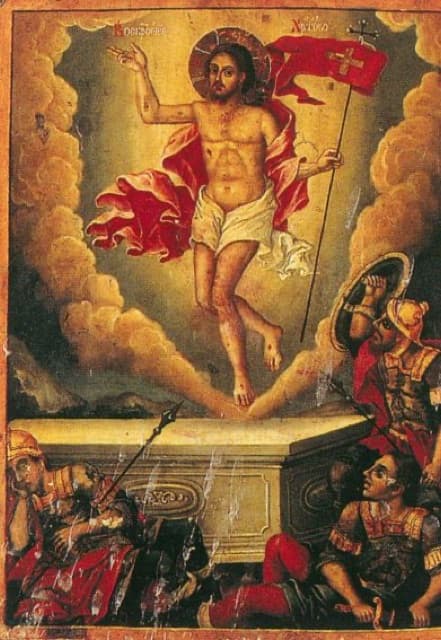
Icon of Pascha (the Resurrection)
Public domain · source

Pascha (the Resurrection)

The Orthodox Pascha icon shows not the empty tomb but the Descent into Hades (the Anastasis): Christ, robed in light and standing on the shattered gates of death, seizes Adam and Eve by the wrist and raises them from their tombs, for they cannot rise by themselves, it is grace that lifts them. Beneath His feet the locks and bonds of Hades lie broken in the darkness, sometimes with Death bound. The righteous of old, David, Solomon, and John the Forerunner, look on, all the dead set free by the Conqueror.

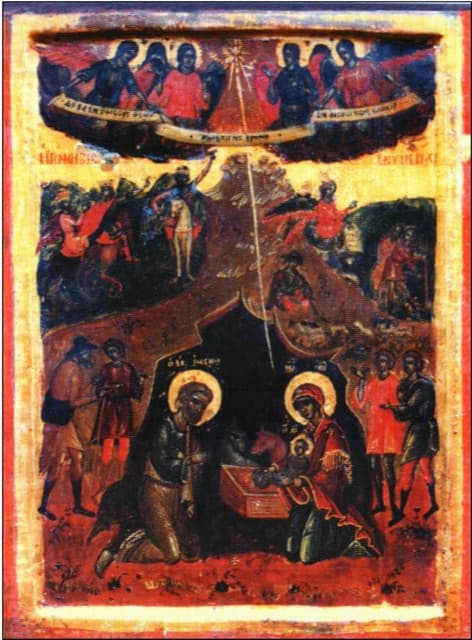
Icon of The Nativity of Christ
Public domain · source

The Nativity of Christ

The Christ-child lies not in a stable but a dark cave, the world in the shadow of death, swaddled in bands like burial cloths and laid in a manger shaped like a tomb, for His birth already points to His death and rising. The ox and the ass keep watch (Isaiah 1:3); a single ray descends from the star. The Theotokos rests at the center; in a corner a troubled Joseph is tempted to doubt, and below, the midwives wash the child, a sign of His true human birth.

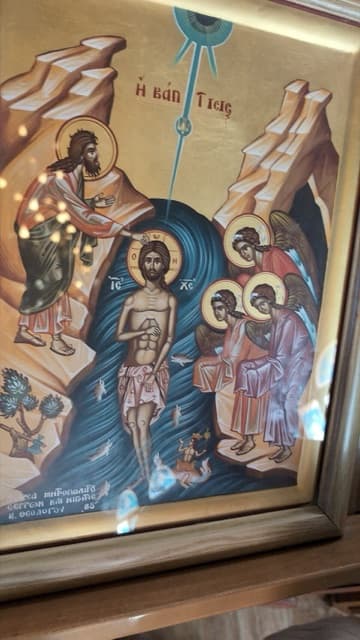
Icon of Theophany (the Baptism)
CC0 · source

Theophany (the Baptism)

Christ stands naked in the Jordan, the waters rising about Him like a watery tomb and a dark cave, for in His baptism He goes down into death and sanctifies the waters. From the opening of heaven the Father's ray descends and the Spirit comes as a dove; John the Forerunner lays his hand on Him while angels wait with veiled hands. Small figures often flee in the stream, the Jordan turned back and the sea fleeing before its Maker (Psalm 113).

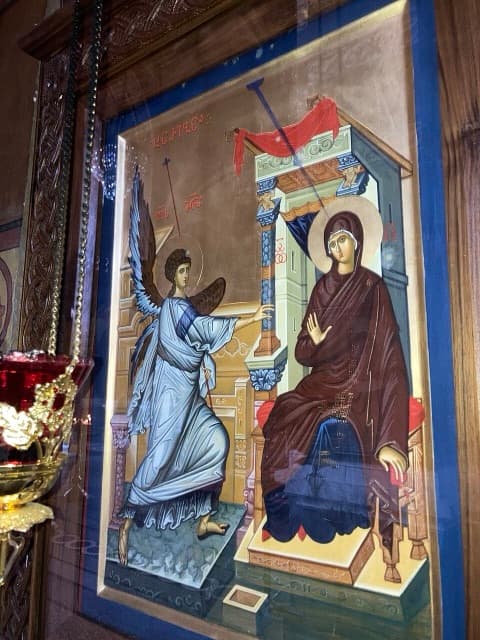
Icon of The Annunciation
CC0 · source

The Annunciation

The archangel Gabriel strides in with a gesture of speech, his wing still lifted from flight; the Virgin, seated, turns with quiet assent. She holds scarlet thread, for tradition has her weaving the veil of the Temple, an image of the flesh being woven for the Word in her womb. A ray descends from above (often with the dove), the Spirit overshadowing her.

Icon of The Transfiguration
Public domain · source

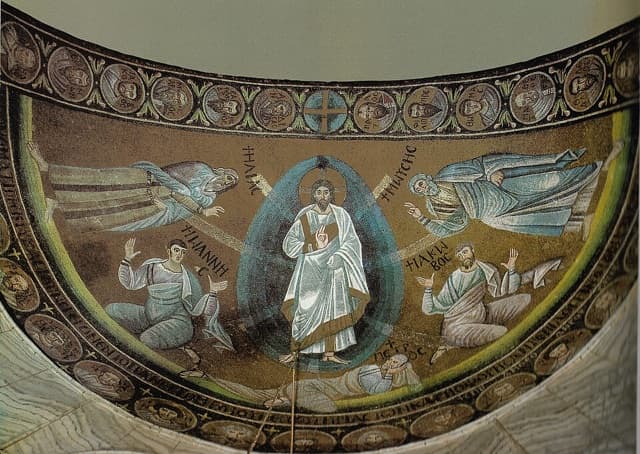
The Transfiguration

On Mount Tabor Christ stands within a mandorla of glory, the uncreated light streaming from Him in rays, with Moses and Elijah (the Law and the Prophets) at His sides. Below, Peter, James, and John are thrown to the ground and shield their eyes, overwhelmed by a light the icon paints not as a glow upon Him but as radiance from within.

Icon of The Dormition
Public domain · source

The Dormition

The Theotokos lies upon her bier surrounded by the apostles, gathered from the ends of the earth. At the center stands Christ in a mandorla, holding in His arms her soul as a small swaddled infant, the roles of the Nativity reversed: He who was once the babe in her arms now receives her into His. Candles, mourning apostles, and angels complete the scene of a death that is a falling-asleep.

Icon of The Ascension
Public domain · source

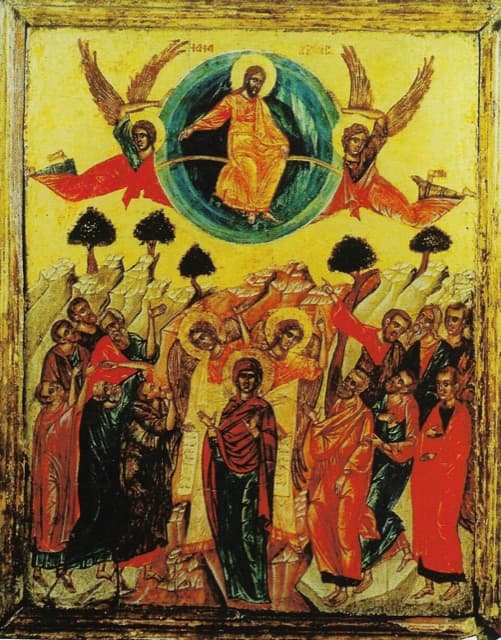
The Ascension

Christ ascends in a mandorla of glory borne up by angels, blessing the Church He leaves. Below, the apostles gaze up in wonder with two angels who promise His return, and at the very center stands the Theotokos, calm and upright, an image of the Church herself left on earth in faith.

Icon of Pentecost
Public domain · source

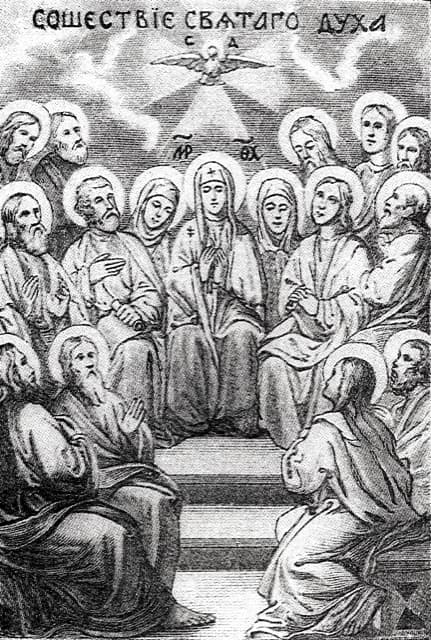
Pentecost

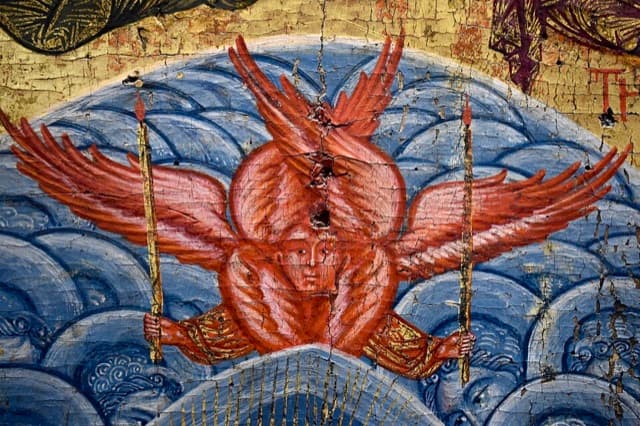
The apostles are seated in a half-circle, an ordered unity rather than a crowd, with tongues of fire resting upon each as the Spirit descends. Below, in the darkness beneath the upper room, an old crowned figure named Cosmos (the world) holds a cloth with scrolls, the nations sitting in darkness and awaiting the Gospel the apostles will carry to them.

Icon of The Entry into Jerusalem
Public domain · source

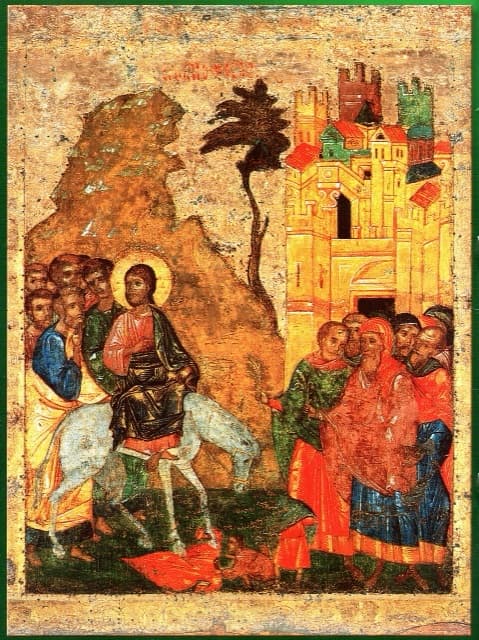
The Entry into Jerusalem

Christ rides toward the city seated on the colt, turning back to His disciples even as He goes to His Passion. Children spread their garments and palms before Him and climb the trees, and the people come out from the gate of Jerusalem to meet the meek King who comes to suffer.

Icon of The Meeting of the Lord
Public domain · source

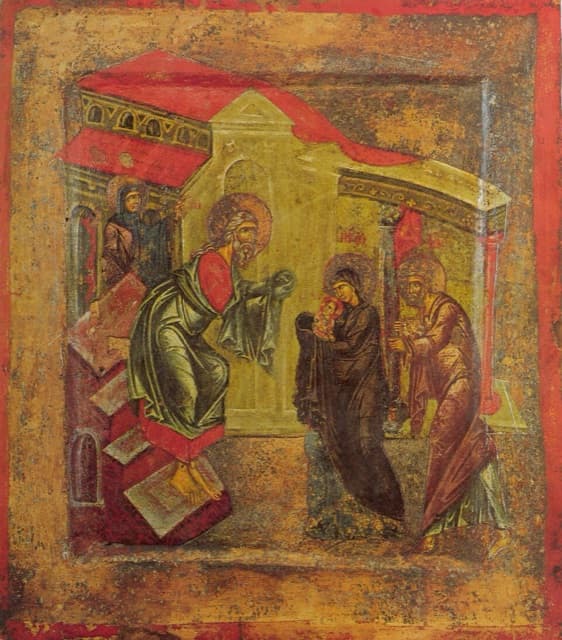
The Meeting of the Lord

At the Temple the elder Symeon, his hands veiled in reverence, receives the forty-day-old Christ into his arms, the Ancient of Days held by an old man who can now depart in peace. The Theotokos offers her Son across the altar; Joseph brings the two turtledoves, and the prophetess Anna points to the Child as the awaited Redeemer.

Icon of The Exaltation of the Cross
CC BY-SA 4.0 · source

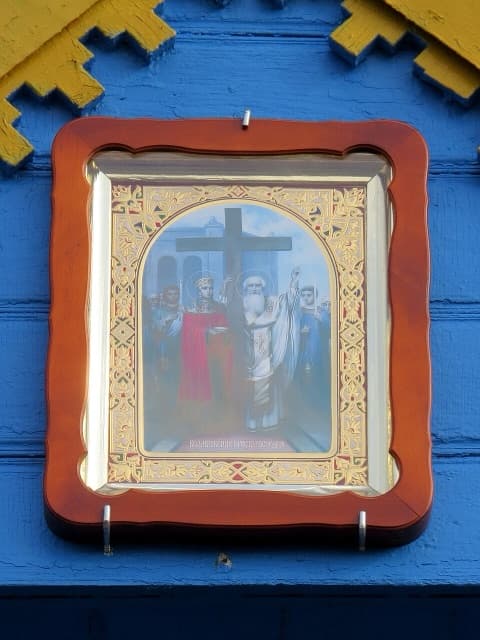
The Exaltation of the Cross

The bishop stands raised on the ambo, lifting the recovered Cross high for all to venerate while deacons support his arms and the people bow. Saints Constantine and Helen, who found the Cross, stand by, and the great church of Jerusalem rises behind, the whole Church gathered around the weapon of victory.

Icon of The Nativity of the Theotokos
Public domain · source

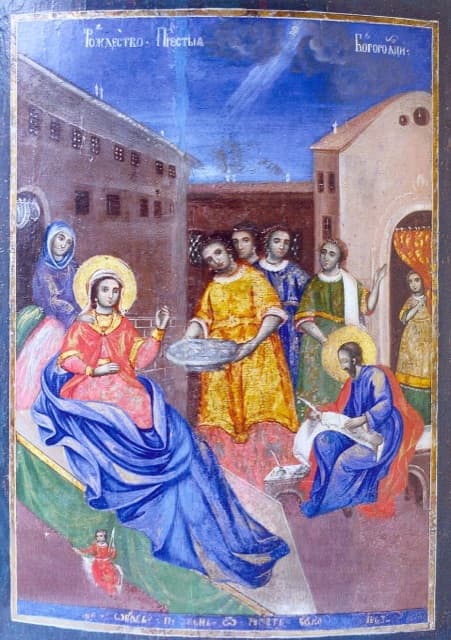
The Nativity of the Theotokos

Saint Anna rests upon her bed after giving birth, attended by handmaidens, while below the newborn Mary is bathed, the ordinary tenderness of a birth that is the dawn of salvation. Joachim often looks on, the long barrenness of the righteous couple ended by God's gift.

Icon of The Entry of the Theotokos
CC BY-SA 4.0 · source

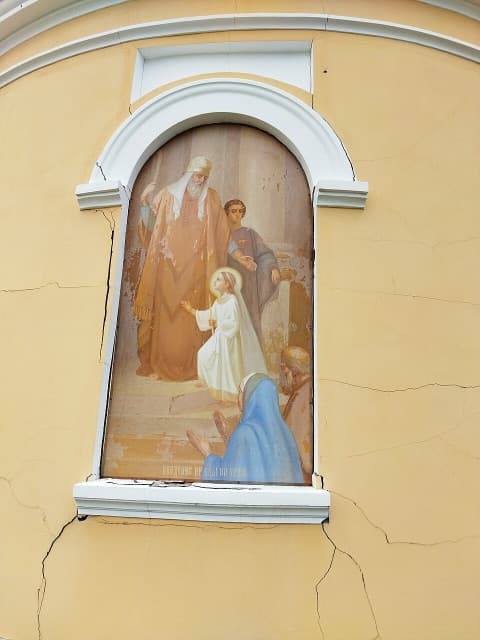
The Entry of the Theotokos

The child Mary, small but unhesitating, mounts the steps of the Temple where the high priest Zacharias stretches out his hands to receive her; her parents and a train of maidens with candles follow behind. In a smaller scene she is shown within the Holy of Holies, fed by an angel, the living temple prepared to contain the One whom the Temple could not.

Iconographic readings explain the received tradition; recensions vary, and an icon is finally read by praying before it, not by description. Feast images are public-domain or Creative Commons works from Wikimedia Commons.